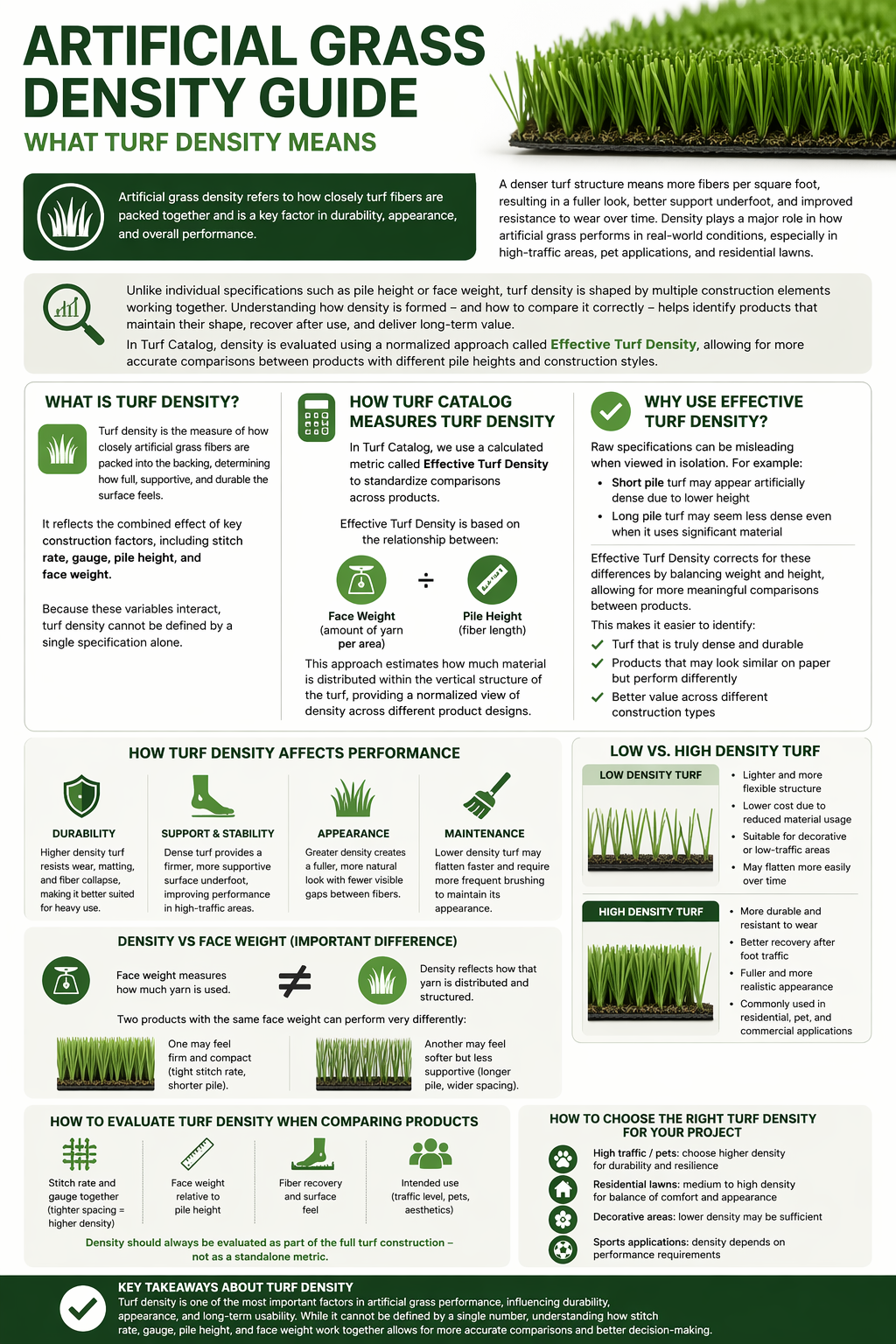
Artificial Grass Density Guide - What Turf Density Means
Artificial grass density refers to how closely turf fibers are packed together and is a key factor in durability, appearance, and overall performance.
A denser turf structure means more fibers per square foot, resulting in a fuller look, better support underfoot, and improved resistance to wear over time. Density plays a major role in how artificial grass performs in real-world conditions, especially in high-traffic areas, pet applications, and residential lawns.
Unlike individual specifications such as pile height or face weight, turf density is shaped by multiple construction elements working together. Understanding how density is formed - and how to compare it correctly - helps identify products that maintain their shape, recover after use, and deliver long-term value.
In Turf Catalog, density is evaluated using a normalized approach called Effective Turf Density, allowing for more accurate comparisons between products with different pile heights and construction styles.
What Is Turf Density?
Turf density is the measure of how closely artificial grass fibers are packed into the backing, determining how full, supportive, and durable the surface feels. It reflects the combined effect of key construction factors, including stitch rate, gauge, pile height, and face weight.
Because these variables interact, turf density cannot be defined by a single specification alone.
How Turf Catalog Measures Turf Density
In Turf Catalog, we use a calculated metric called Effective Turf Density to standardize comparisons across products.
Effective Turf Density is based on the relationship between:
- Face weight (amount of yarn per area)
- Pile height (fiber length)
This approach estimates how much material is distributed within the vertical structure of the turf, providing a normalized view of density across different product designs.
Why Use Effective Turf Density
Raw specifications can be misleading when viewed in isolation. For example:
- Short pile turf may appear artificially dense due to lower height
- Long pile turf may seem less dense even when it uses significant material
Effective Turf Density corrects for these differences by balancing weight and height, allowing for more meaningful comparisons between products.
This makes it easier to identify:
- Turf that is truly dense and durable
- Products that may look similar on paper but perform differently
- Better value across different construction types
How Turf Density Affects Performance
Durability
Higher density turf resists wear, matting, and fiber collapse, making it better suited for heavy use.
Support & Stability
Dense turf provides a firmer, more supportive surface underfoot, improving performance in high-traffic areas.
Appearance
Greater density creates a fuller, more natural look with fewer visible gaps between fibers.
Maintenance
Lower density turf may flatten faster and require more frequent brushing to maintain its appearance.
Low vs. High Density Turf
Low Density Turf
- Lighter and more flexible structure
- Lower cost due to reduced material usage
- Suitable for decorative or low-traffic areas
- May flatten more easily over time
High Density Turf
- More durable and resistant to wear
- Better recovery after foot traffic
- Fuller and more realistic appearance
- Commonly used in residential, pet, and commercial applications
Density vs Face Weight (Important Difference)
Turf density and face weight are closely related but not identical.
- Face weight measures how much yarn is used
- Density reflects how that yarn is distributed and structured
Two products with the same face weight can perform very differently:
- One may feel firm and compact (tight stitch rate, shorter pile)
- Another may feel softer but less supportive (longer pile, wider spacing)
How to Evaluate Turf Density When Comparing Products
To accurately compare artificial grass density, consider:
- Stitch rate and gauge together (tighter spacing = higher density)
- Face weight relative to pile height
- Fiber recovery and surface feel
- Intended use (traffic level, pets, aesthetics)
Density should always be evaluated as part of the full turf construction - not as a standalone metric.
How to Choose the Right Turf Density for Your Project
- High traffic / pets: choose higher density for durability and resilience
- Residential lawns: medium to high density for balance of comfort and appearance
- Decorative areas: lower density may be sufficient
- Sports applications: density depends on performance requirements
Key Takeaways About Turf Density
Turf density is one of the most important factors in artificial grass performance, influencing durability, appearance, and long-term usability. While it cannot be defined by a single number, understanding how stitch rate, gauge, pile height, and face weight work together allows for more accurate comparisons and better decision-making.