Best Artificial Grass for Heat Resistance
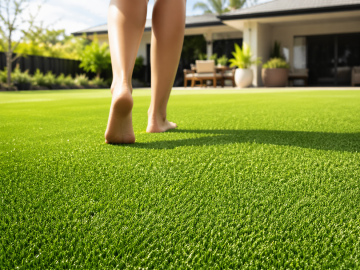
Artificial grass can get hot under direct sunlight, but not all turf performs the same. The best artificial grass for heat resistance is designed to reduce surface temperatures and stay comfortable even in warm climates. Products with advanced cooling features, lighter yarn colors, and optimized density can significantly improve how turf feels underfoot during peak heat.
The Heat Comfort Score is a standardized rating that measures how well artificial grass manages heat buildup. It combines multiple factors including yarn color brightness, pile height, material type, infrared (IR) reflectivity, and turf density. A higher score (9/10 and above) indicates turf that reflects more heat, allows better airflow, and maintains lower surface temperatures compared to standard synthetic grass.
Products listed below are selected based on a Heat Comfort Score above 9/10, meaning they are engineered for maximum cooling performance using advanced materials and heat-reducing technology.
| Product | Heat Comfort Score | Pile Height in | Face Weight oz/yd² | Effective Turf Density |
|---|---|---|---|---|
| Heat Comfort Score
9.5/10
confidence 100
| Pile Height in 1 3/4 | Face Weight oz/yd²55 | Effective Turf Density 41.95 | |
| Heat Comfort Score
9.5/10
confidence 100
| Pile Height in 1 3/16 | Face Weight oz/yd²35 | Effective Turf Density 39.34 | |
| Heat Comfort Score
9.5/10
confidence 100
| Pile Height in 1 3/8 | Face Weight oz/yd²55 | Effective Turf Density 53.39 | |
| Heat Comfort Score
9.5/10
confidence 100
| Pile Height in 1 1/2 | Face Weight oz/yd²60 | Effective Turf Density 53.39 | |
| Heat Comfort Score
9.5/10
confidence 100
| Pile Height in 1 3/8 | Face Weight oz/yd²50 | Effective Turf Density 48.54 | |
| Heat Comfort Score
9.3/10
confidence 100
| Pile Height in 1 1/2 | Face Weight oz/yd²70 | Effective Turf Density 62.29 | |
| Heat Comfort Score
9.2/10
confidence 100
| Pile Height in 1 1/4 | Face Weight oz/yd²80 | Effective Turf Density 85.43 | |
| Heat Comfort Score
9.2/10
confidence 100
| Pile Height in1 | Face Weight oz/yd²60 | Effective Turf Density 80.09 | |
| Heat Comfort Score
9.2/10
confidence 100
| Pile Height in 1 1/2 | Face Weight oz/yd²58 | Effective Turf Density 51.61 | |
| Heat Comfort Score
9.2/10
confidence 100
| Pile Height in 1 3/8 | Face Weight oz/yd²55 | Effective Turf Density 53.39 | |
| Heat Comfort Score
9.2/10
confidence 100
| Pile Height in2 | Face Weight oz/yd²60 | Effective Turf Density 36.04 | |
| Heat Comfort Score
9.1/10
confidence 100
| Pile Height in 1 3/4 | Face Weight oz/yd²80 | Effective Turf Density 61.02 | |
| Heat Comfort Score
9.1/10
confidence 100
| Pile Height in 1 7/8 | Face Weight oz/yd²75 | Effective Turf Density 48.06 | |
| Heat Comfort Score
9.1/10
confidence 100
| Pile Height in 1 5/8 | Face Weight oz/yd²100 | Effective Turf Density 82.15 | |
| Heat Comfort Score
9.1/10
confidence 100
| Pile Height in 1 5/8 | Face Weight oz/yd²100 | Effective Turf Density 82.15 | |
| Heat Comfort Score
9.1/10
confidence 100
| Pile Height in 1 3/4 | Face Weight oz/yd²68 | Effective Turf Density 51.87 |
Why These Artificial Grass Products Stay Cooler
Artificial grass surfaces can heat up quickly in direct sunlight, but the products listed above are specifically designed to reduce heat absorption and improve comfort. Each turf meets a Heat Comfort Score of 9/10 or higher, meaning it performs exceptionally well across multiple cooling-related factors rather than relying on a single feature.
The most important factor is infrared (IR) reflectivity, which determines how much sunlight is reflected instead of absorbed. Turf with higher IR reflectivity stays noticeably cooler, especially during peak midday heat. This is supported by lighter yarn colors, which naturally absorb less heat compared to darker green tones, and polyethylene-based materials, which tend to retain less heat than more rigid fibers.
Structure also plays a key role. Moderate pile height and balanced turf density allow for better airflow between fibers, helping heat dissipate instead of becoming trapped near the surface. Turf that is too dense or too compact can hold heat longer, while well-balanced construction improves ventilation and overall comfort.
How to Choose Heat-Resistant Artificial Grass
If heat reduction is a priority, focus on turf with:
- High IR reflectivity or cooling technology
- Lighter yarn color blends
- Polyethylene fibers for lower heat retention
- Balanced density for airflow (not overly compact)
- A Heat Comfort Score above 9/10
For the best results, compare products not just by appearance, but by measurable heat performance. Turf with a high Heat Comfort Score provides a more comfortable surface year-round, especially in hot and sunny climates.
Artificial Grass and Window Reflection Heat Damage
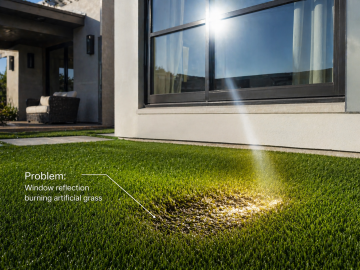
Even the most heat-resistant artificial grass can be damaged by reflected sunlight from windows. This is not caused by normal sun exposure, but by concentrated heat created when sunlight reflects off low-emissivity (Low-E) glass windows. These modern energy-efficient windows can act like a mirror, focusing sunlight onto a small area of turf and significantly increasing surface temperatures.
In some cases, reflected light can raise temperatures well beyond normal conditions - hot enough to melt or deform synthetic fibers, especially polyethylene-based turf. This can result in visible damage such as fiber shrinkage, hardening, or glossy burn spots. Unlike general heat buildup, this type of damage is highly localized and can occur even when surrounding areas remain unaffected.
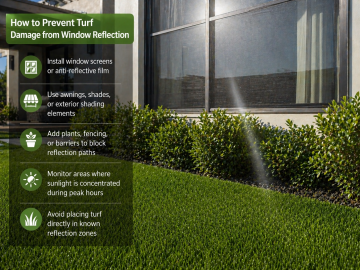
Choosing artificial grass with a high Heat Comfort Score helps reduce overall heat absorption, but it does not fully prevent damage from concentrated reflections. If your installation area includes reflective windows or glass surfaces, it's important to evaluate sun angles and consider preventative measures such as window screens, films, landscaping barriers, or adjusting turf placement.
How to Prevent Turf Damage from Window Reflection
- Install window screens or anti-reflective film
- Use awnings, shades, or exterior shading elements
- Add plants, fencing, or barriers to block reflection paths
- Monitor areas where sunlight is concentrated during peak hours
- Avoid placing turf directly in known reflection zones